
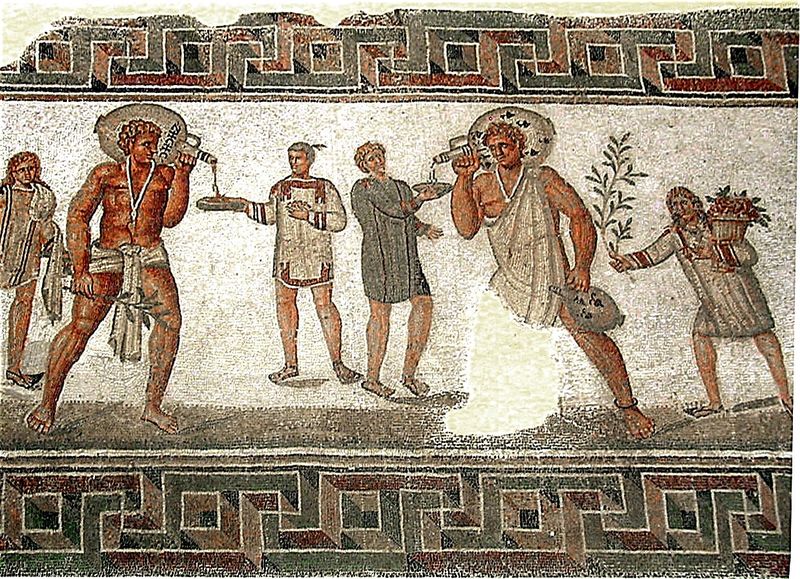
The Hebrew Bible’s word for servant, ‘ebed, makes no distinction between slave and free; without further details, we cannot tell which is which in any given verse. Thankfully, in the New Testament, there is only one word that can mean “slave”: doulos. The other word for servant, diakonos, never can mean “slave.” And diakonos has other familiar meanings: “minister,” and “deacon,” a word we get straight from the Greek original.
How do we know that doulos means “slave”? Look at verses that distinguish “slave” and “free,” like Galatians 3:28, where in Christ there is “neither slave nor free.” Or look at 1 Corinthians 7:22, where Paul speaks of how Christ reverses the status of slave and free. We find pairings of slave and free in 1 Corinthians 12:13, and Revelation 6:15, 13:16, and 19:18. Peter teaches that we should live as “free” people, but should not use our freedom as an excuse for evil, but should instead live as “slaves” of God (1 Peter 2:16). From the way the word is used, it is clear that a doulos is not free, but is totally owned by another human.
Jesus says, “Whoever would be great among you must be your diakonos, and whoever would be first among you must be doulos of all” (Matthew 20:26-27 = Mark 10:43-44). The two terms are not synonymous. Verb forms of doulos also emphasize the sense of slavery rather than mere service. Douloō means to enslave; in John 8:33, listeners object to Jesus’ claim that he will make them free by denying that they have been “enslaved” to anyone. Titus 2:3 teaches that Christian women should not be “enslaved” to alcohol. Douleō means to serve as a slave, as in Matthew 6:24, “No one can serve two masters.”
Paul proudly introduces himself as a doulos of Christ five times, in Romans 1:1, 2 Corinthians 4:5, Galatians 1:10, Philippians 1:1, and Titus 1:1. In the same breath, he claims to be both an apostle and a “slave”! Other epistle writers self-identify as slaves of Christ in James 1:1, 2 Peter 1:1, and Jude 1:1. In the book of Revelation, believers are often reminded that we are all “slaves” of Christ.
Paul uses slavery as an image of obedience in Romans 6:16-22: we are slaves to either sin or righteousness, to whichever we submit to. (Paul apologizes for using the image, because he knows this could be a sore spot for many in his audience.) We find the same image in 2 Peter 2:19: false teachers promise them freedom, but they themselves are slaves of corruption.
(By the way, good luck trying to do this study using Strong’s or Young’s Concordance. Our English word “slave” occurs only once in the entire King James Version!)
Now, there are places where it is not totally clear whether the doulos has a human owner. In Luke 7:1-10, we cannot be sure whether the Roman sergeant’s doulos is a servant or a slave. But the diakonos never gives us the telltale signs of slavery that I have enumerated for doulos. The diakonos never serves a kyrios or “master.”
How does the Greek Old Testament translate cases of servitude? Surprisingly, doulos does not get used until Leviticus 25, where we find slaves taken from the surrounding pagan nations. So what word does the Septuagint use for earlier cases of servitude? In the case of Hebrew debt slavery in Exodus 21, it uses the word pais, which can mean both “servant” and “child.” (When the New Testament speaks of Jesus as God’s pais, such as in Acts 3:13 and 4:27, it is hard to tell which meaning is intended, or both!)
The standard Hebrew word for “slave” cited at the beginning of this study refers to both kinds of servant, free and not free. It also just as often means simply “worker” (in Genesis 4:2, Cain is a “worker of the soil”). But the plural form of this word for servant or slave, the form used to mean the sum total of all servitude, is always translated “bondage.” It is used this way nine times, all of them referring to Egypt as the “house/place of bondage.” The related noun ‘abodah is translated “bondage” eight times by the KJV, but 112 times as simply “service.” In the Hebrew language’s word for slave, context is everything; it’s all there is.
Let’s turn to diakonos. While doulos emphasizes our total ownership by our Master, diakonos and its related noun diakonia emphasizes service. Unlike doulos, diakonos is the only word that fits the idea of “ministry,” service performed freely and not by compulsion. We find Martha serving this way in Luke 10:40. Christ himself serves this way (Luke 22:27, Romans 15:8), definitely not service to human overlords.
Seven times Paul refers to himself as a diakonos (servant or “minister”). He also refers to Timothy (1 Timothy 4:6), Tychicus (Ephesians 6:21), and Epaphras (Colossians 1:7) this way. He even refers to the government authority as a “minister/servant of God” (Romans 13:4).
The diakonos or “deacon” becomes an office of the church in 1 Timothy 3:8, where Paul lists qualifications for those who would serve in this official capacity. He also lists qualifications for “the women” (or is it “the wives”?), which might be a group who become outright “deaconesses” within 50 years, when a Roman governor says that he has gotten his intel on this new cult of “Christians” by torturing women he calls ministrae (the Latin form of diakonoi). Whether these are merely wives of deacons whom Paul is describing to Timothy, or whether they are deaconesses, one can argue either way.
So what are we to think of Pheobe, whom Paul says is a diakonos of the church in the Corinthian suburb of Cenchreae (Romans 16:1)? Is she a “servant,” a “deacon,” or a “minister”? She is the one who hand-delivers Paul’s epistle to Rome, very possibly on a business trip. Paul says she has been a prostatis (patroness or ombudsman, someone who’s got clout with government authorities) for many, including himself. Whatever Paul allows women to do in the church, we need to factor Phoebe into that picture. We can’t say that Paul doesn’t surround himself with strong, capable women.
The line between slaves and servants is somewhat blurred in the Hebrew Bible, but much less so in the New Testament. The word doulos helps us tell the two apart. Only Christ owns us and deserves our total obedience. And the words diakonos and diakonia point us to all kinds of non-coerced service or ministry, whatever we choose to call it.
