
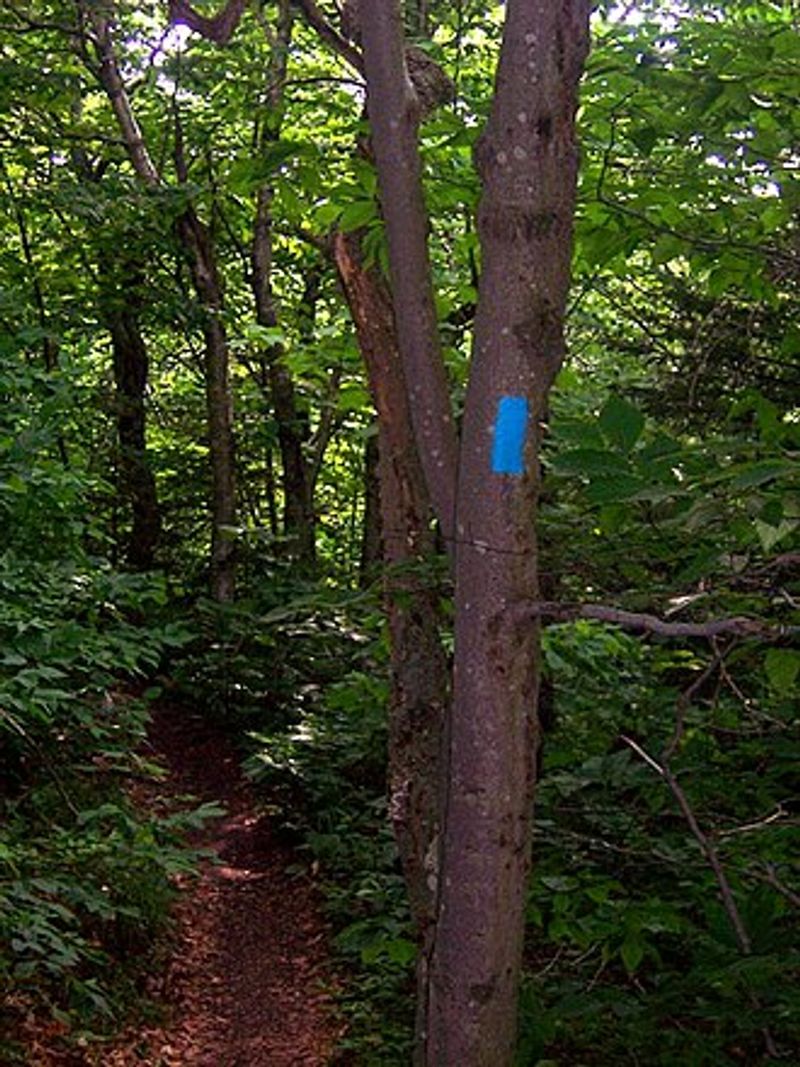
“Where in the blue blazes do you think you’re going?” On the Appalachian Trail, I am very thankful for the painted blazes on trees (or rocks, if there are no trees). Out West, the places where I hike don’t give me those blazes, so that sometimes we are on our own as we trace our way through brush or a boulder field. Blazes on the A.T. help reduce one’s chances of getting lost.
On the A.T., the white blazes assure me that I am on the official trail. The blue blazes tell me that I am on a side trail. That side trail could lead me to a beautiful vista, or to a campground or water source that is off the trail and usually out of sight. Last year, on Mother’s Day, I used a blue blaze trail to get up to the A.T. in the Smokies to meet up with my wife. (She was on a long stretch where there was no road access. That’s what was so nice about the Shenandoahs: unlike in the Smokies, we had constant road access.)
But blue blazes could be the wrong trail, a trail that will take me somewhere that I don’t want to go. When we come to a fork in the trail, and there is no helpful sign (and there won’t always be one), taking the wrong color blaze can put us miles away from that parking lot or road that we had planned as our trail’s end for the day.
Sometimes, in the dark forest, you need to watch very closely to make sure those blazes are white and not blue. But as you hike, you also have to pay attention to make sure you haven’t missed those white blazes. I can be trotting along making wonderful time, and then realize that I haven’t seen a white blaze in several minutes. Oops!
Sometimes you can turn around and see a white blaze for hikers who are going the opposite direction; then, at least you know you’re on the right trail, although you still need to find a white blaze in the direction you’re going. But sometimes we may have to retrace our steps a lot further than we wish until (hopefully!) we find a white blaze again.
Twice in the past two years, I’ve had this happen to me worse than I would have wished. On our recent hike in Maryland, where my wife and I had just passed each other (she was headed south, to where I would pick her up after I reached the car where she parked it), I was coming down the highest point on the trail that day through an awful stretch of boulders and brush, where I found that I had lost the trail.
I climbed part way back up the trail – nothing. So I sat down and ate lunch. When I got up and started looking again, I saw a hiker coming downhill. I went to ask him where the trail was, and there I finally started seeing, not a trail, but at least the northbound white blazes I was looking for. (That stretch of trail was nasty in both directions, uphill and downhill.)
The same thing happened to me last year in Nahamsha (New Hampshire). This time I was alone on a blue blaze, trying to reach the A.T. via a shortcut. The blazes disappeared, or so it seemed. I ended up accidentally climbing a waterfall that was NOT on the trail. So what did I do? Again, I sat down and ate lunch. After lunch, I retraced my steps just far enough to find where I had gone wrong. I missed a blaze.
Life is a wilderness trail. God has given us white blazes to follow. We need to make sure we don’t lose sight of them. At the same time, we need to beware of blue blazes that look like the main trail, but will take us far away from where we thought we were going. Some trails are false. (If you know me, you may know which trails I’m thinking of.) If we follow those false trails, we will eventually run out of food and water, and may never find the way out of the wilderness. So if we do figure out that we’re on a blue blaze, or that we have lost the right trail, we need to turn around, to “repent” (the Biblical term).
