
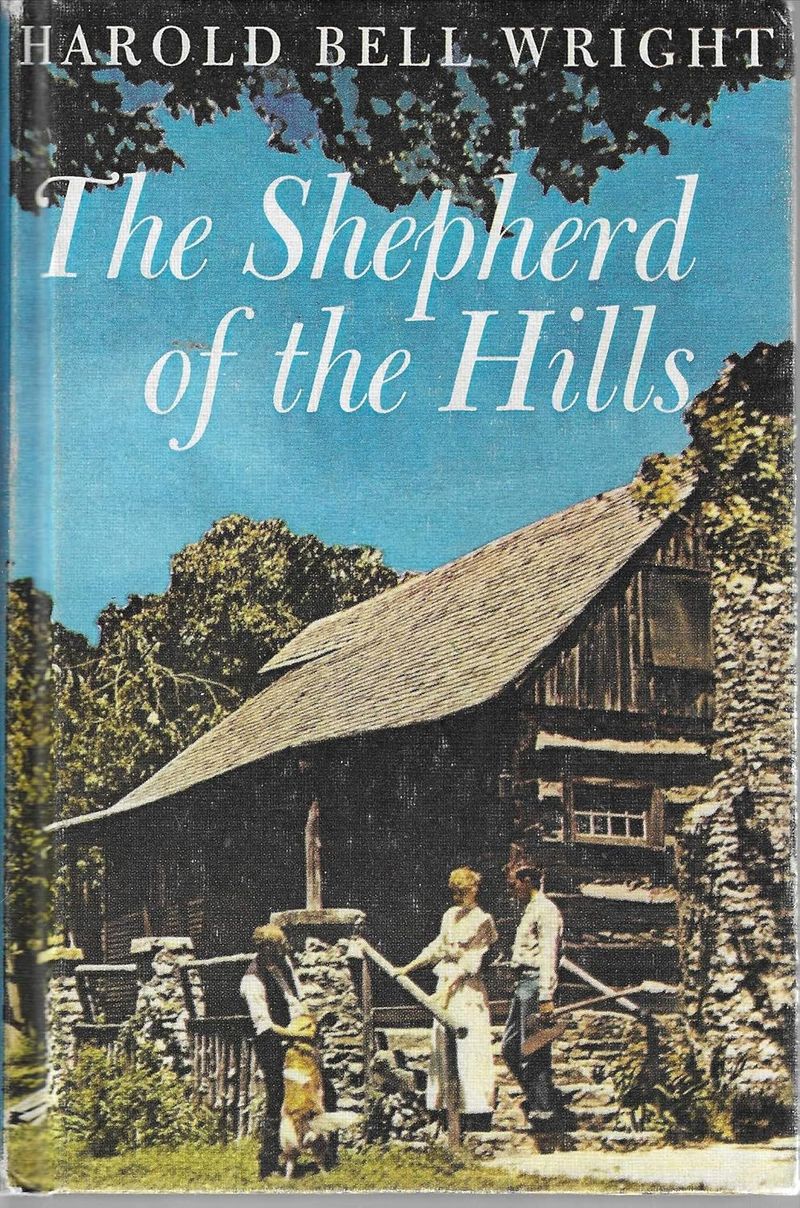
Recently I re-read one of my father’s favorite books, Harold Bell Wright’s The Shepherd of the Hills. I also re-read Wright’s The Calling of Dan Matthews, and (for the first time) The Uncrowned King, Wright’s quasi-credo in allegory form, which I found to be an Ozark version of Jonathan Livingston Seagull (I jokingly call it “Jonathan Livingston Buzzard”).
It’s been decades since I read the first two books. Shepherd is full of concurrent plots and surprising plot twists. We have a strong, virtuous young backwoodsman and a girl much like him, separated by a stereotypic 98-Pound-Weakling who plans to take the girl to the city to marry and enjoy sharing the wealth of his rich uncle. What can possibly persuade her not to go? Eventually (spoiler alert!), the strong young man and his girl walk off into the sunset through the wooded hills on that trail that nobody knows how old it is.
Yet there is also the stranger, a city preacher who comes to the hills to escape the world and start a new life. He becomes a shepherd, in more ways than one. People welcome his down-to-earth wisdom. Occasionally, we also hear pithy quotes on human nature from an unseen character called “Preachin’ Bill.” The unstated theology woven throughout the story is that you can have the religion of Jesus without the Church.
The Calling of Dan Matthews hit me like a ton of bricks, right after my first tumultuous pastorate. At the time, it sounded so much like what I had just been through, that I thought, “If I had read this book ten years ago, I might have never decided to become a pastor.” After my recent re-reading, I can see major differences between Dan’s story and my own, but the similarities are still creepy.
Yet the cynicism about the Church that lay hidden in Shepherd is now jacked up on steroids in Dan Matthews. I may have felt many times that the Church was anything but the Bride of Christ, but never with the passion that Harold Bell Wright shows.
Dan is the son of the hero and heroine of Shepherd. Although not raised in a church, Dan becomes a pastor of a town church, under the thumb of two elders who control the place, with the supernatural help of the Ally, who always attends every church service and Ladies’ Aid meeting.
Dan meets a young nurse named Hope, who becomes the mouthpiece of a torrent of the author’s anti-church cynicism. Dan believes Hope is meeting the needs that the Church should be meeting. Hope longs for someone like Dan to reform the church. The two are drawn to each other, but then Dan must choose between her and the church. Then, sadly, Dan loses not only the girl, but the church as well. But when Dan returns home to the hilltop where his mother used to look out over the hills (spoiler alert!), he is surprised to find Hope waiting for him! Boy and girl find each other again, and walk that trail that is nobody knows how old, to where Dan’s Mom and Dad meet them.
The Uncrowned King reads like a Pilgrim’s Progress, although the pilgrim is called by the Muslim term Hadji. The resemblance to Seagull is in the way the pilgrim endures a long journey through the Desert of Facts to the Temple of Truth, where he meets Thyself, where he is told that eyes, ears, brains, hearts, and throats that are choked by “things” can never see, hear, think, or speak Truth.
The Temple of Truth is in a kingdom called Allthetime ruled by a king named Really-Is, whose capital city is DaybyDay. Really-Is and his twin brother Seemsto-Be are sons of a past king What-Soever-Youthink, who permitted everyone to worship as they pleased. Really-Is and Seemsto-Be journey together to an even more distant kingdom of Yettocome, where they meet Fancy and Imagination, the daughters of King Lookingahead.
When they hear that their father is dead, Really-Is and Seemsto-Be race back home. The crown belongs to Really-Is, but Seemsto-Be gets crowned, but the crown fades, the people reject Seems-to-Be, and just before Really-Is is crowned, the crown disappears. The word goes out: “The Crown is not the kingdom, nor is one King because he wears a crown.” At the very end, the Pilgrim lays his offering on the altar of the god That-Can-Never-Change. His offering was Himself. If the Uncrowned King is supposed to be the King of Kings we know, he certainly is not the One “from whom earth and sky fled away, and no place was found for them.” (Revelation 20:11)
Where does the Shepherd of the Ozark hills lead us? Does he lead us here? Maybe not. Perhaps he merely means to lead us to a religion where we can be good without the help of that hopeless institution called the Church, which good people cling to because they don’t know where else to turn. All we learn about Jesus from this writer is that he taught us how to live, and well-meaning people crucified him.
It is not surprising that my father liked Harold Bell Wright’s books so much. The theology of Wright’s Ozark novels fit my father’s theology to a T. Perhaps I was his Dan Matthews, whom he hoped would reform the Church that turned him off to Jesus. Certainly my wife is no skeptic like Dan’s girl was. Rather, like Dan and Hope, I’d like to think the two of us are partners in what Dan set out to do. I am thankful that God sent her to that parking lot, to meet the bus that took us to Silver Falls, Oregon, where we walked another trail that is nobody knows how old.
